ECHO: Giving AI Agents a Graph-Powered Memory of Software Projects
The Problem: Software Projects Have Connected Context
Software projects generate a constant stream of decisions, dependencies, tasks, and technical discussions. The challenge is not simply storing this information — it is understanding how the pieces connect.
For example, changing an authentication design may affect several downstream tasks. A conventional task list might show the individual tasks, but understanding the consequences requires tracing their relationships.
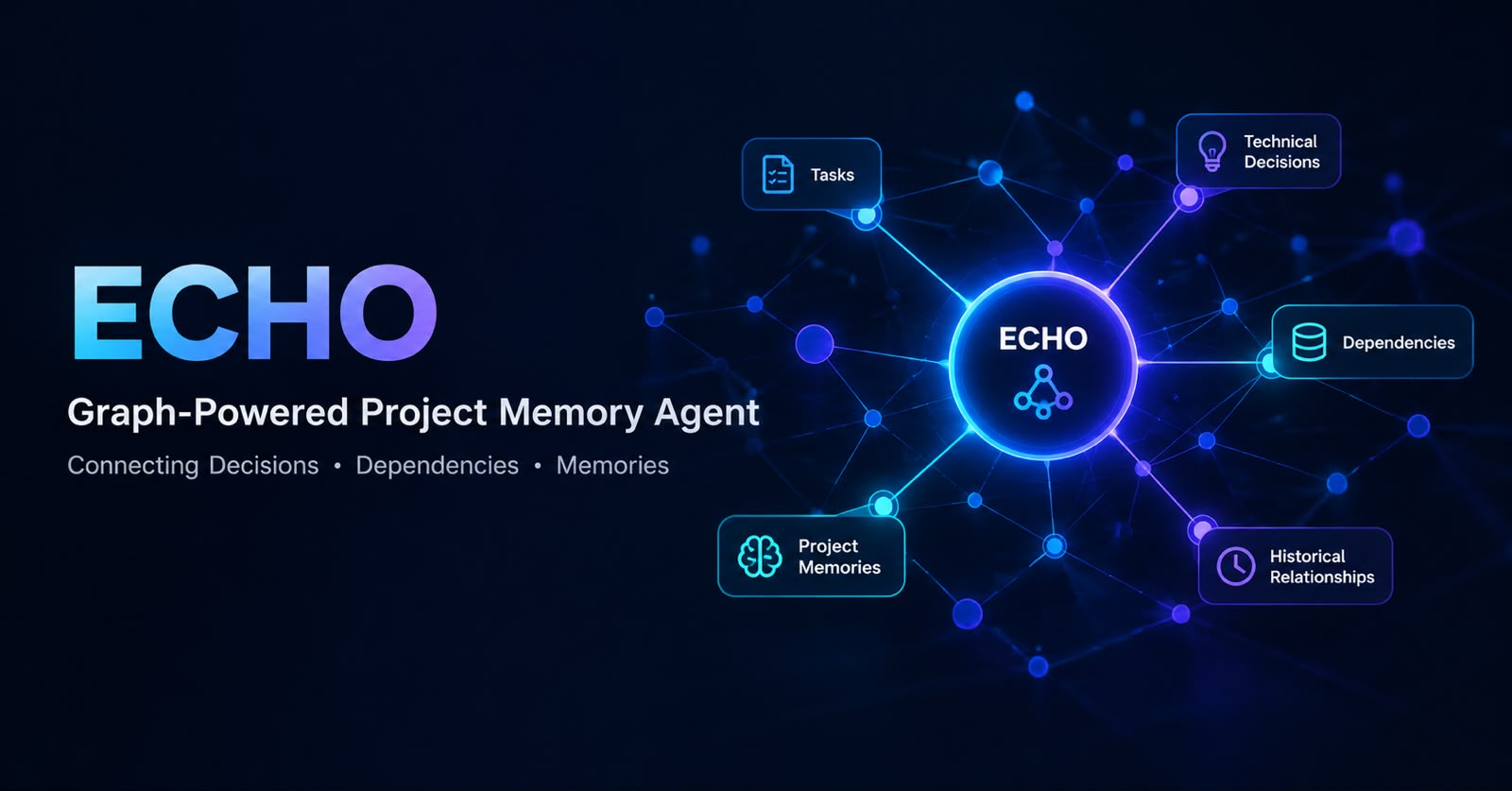
ECHO is a graph-powered project memory agent designed to make those relationships easier to explore and explain.
What Is ECHO?
ECHO stands for a graph-powered approach to project memory and impact intelligence. It is a Python-based prototype built around FalkorDB.
Its goal is to help developers answer questions such as:
Which tasks could be affected by a technical decision?
What relationship connects a decision to a downstream task?
What project memories are associated with a particular subject?
Which earlier decision was superseded by a newer one?
Rather than treating project information as disconnected notes, ECHO models entities and their relationships in a graph.
Why Use a Graph Database?
Project context is inherently connected. Tasks depend on other tasks, decisions affect parts of a project, memories relate to specific subjects, and decisions can supersede earlier decisions.
A graph represents these connections explicitly.
ECHO uses FalkorDB as its primary graph database and Cypher queries to traverse relationships, retrieve relevant information, and explain how connected entities relate to one another.
The graph is central to the prototype's functionality, rather than simply being a visualization layer.
Three Core Capabilities
1. Graph-Based Impact Analysis
A technical decision can have consequences beyond the component it directly changes.
ECHO traverses graph relationships to identify downstream tasks that may be affected. It also returns evidence paths that help explain why a task was included in the impact analysis.
In the synthetic demonstration dataset, ECHO identifies seven potentially affected tasks for a sample decision and shows the graph paths supporting those results.
This makes the output more inspectable than a list of task names without supporting evidence.
2. Persistent Project Memory
ECHO supports storing project memories and linking them to relevant subjects in the graph.
This structure makes it possible to retrieve memories associated with a particular project entity instead of relying only on isolated text entries.
The prototype also supports optional recording provenance, allowing a memory to be associated with information about who recorded it or where it came from when those details are provided.
3. Decision History
Project decisions change over time. A newer decision may replace an earlier one, but the earlier decision can still provide useful historical context.
ECHO represents this relationship with a SUPERSEDES edge from the newer decision to the older decision.
Its decision-history functionality can retrieve connected earlier and later decisions, helping preserve context about how project choices evolved.
The current implementation focuses on connected decision history rather than providing a complete branching history interface.
How FalkorDB Powers ECHO
FalkorDB is the primary graph database in ECHO.
The prototype models project entities, tasks, decisions, and memories as nodes. Relationships represent connections such as dependencies, impact, subject associations, and decision supersession.
Python connects the application to FalkorDB, while Cypher queries perform graph traversals and retrieve connected information.
This enables ECHO to combine three important capabilities:
Relationship-aware retrieval: find information through graph connections.
Explainable impact analysis: show evidence paths connecting a decision to affected tasks.
Persistent decision context: connect memories with project entities and preserve relationships between decisions.
These capabilities demonstrate how graph databases can serve as a foundation for practical AI-agent memory and connected-data reasoning.
Testing the Prototype
ECHO was tested locally against a running FalkorDB instance using synthetic project data.
The verification process included automated tests and repeatable demonstration scripts.
The project test suite passed 63 tests in the verified local environment. The impact-analysis demonstration identified seven affected tasks, and the memory demonstration exercised memory retrieval and decision-history behavior.
These results validate the tested prototype behavior; they do not establish production readiness or performance at large scale.
What I Learned
Building ECHO reinforced three important ideas.
First, relationships can be as important as the information itself. A task or decision becomes more useful when its connections to other project entities are explicit and queryable.
Second, explanations matter. An impact-analysis result is more useful when a developer can inspect the path connecting the original decision to the affected task.
Third, verification matters when using AI-assisted development. AI coding tools helped with implementation, while I ran the tests and demonstrations against a local FalkorDB instance to check the resulting behavior.
Current Limitations and Future Work
ECHO is currently a prototype demonstrated with synthetic data and a local setup. It does not yet have a public hosted deployment or integrations with live software-development platforms.
Potential next steps include:
A user interface for exploring project graphs and evidence paths.
Integrations with authorized issue trackers and project documentation.
More comprehensive handling of branching decision histories.
Evaluation against larger and more realistic project datasets.
Further testing of reliability, performance, and practical usefulness.
These improvements would help assess how ECHO performs in real development workflows.
Conclusion
ECHO explores how FalkorDB can power project memory and impact analysis by making relationships between tasks, decisions, and memories explicit.
Its current prototype combines graph-based impact analysis, evidence-path explanations, persistent memory retrieval, and decision-history queries.
The central idea is simple: when project knowledge is connected, an agent can do more than retrieve isolated facts — it can follow relationships and show how pieces of context fit together.
Explore the Project
Source code, setup instructions, and demonstration scripts:
GitHub: ECHO — Graph-Powered Project Memory Agent
ECHO is a work in progress, and the current implementation is a locally tested prototype built with Python and FalkorDB.
Comments
Join the discussionNo comments yet. Be the first to comment.